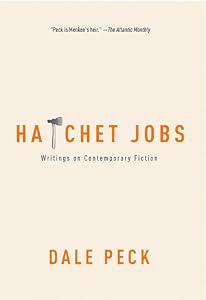
Hatchet Jobs: Writings on Contemporary Fiction By Dale Peck
Since the initial publication of Hatchet Jobs, the groves of literary criticism have echoed with the clatter of steel on wood. From heated panels at Book Expo in Chicago to contretemps at writers’ watering holes in New York, voicesâ€"even fistsâ€"have been raised.
Peck’s bracing philippic proposes that contemporary literature is at a dead end. Novelists have forfeited a wider audience, succumbing to identity politicking and self-reflexive postmodernism. In the torrent of responses to this fulguration, opinions were not so much divided as cleaved in two with, for example, Carlin Romano contending that “Peck’s judgments are worse than nastyâ€"they are hysterical†and Benjamin Schwarz retorting that “in his meticulous attention to diction, his savage wit, his exact and rollicking prose and his disdain for pseudointellectual flatulence, Dale Peck is Mencken’s heir.â€
Hatchet Jobs includes swinging critiques of the work of, among others, Sven Birkerts, Julian Barnes, Philip Roth, Colson Whitehead, Jim Crace, Stanley Crouch, and Rick Moody.
Hatchet Jobs: Writings on Contemporary Fiction
I don't have much patience for pompous blowhards. Pompous blowhard, thy name is Dale Peck.
Are there some valid points made in this book? Yes, some. That being said, I have far more respect when the opinions come from someone who has talent that outshines those who are the subject of the harsh criticism. Peck is not even close. It's as though a man who has crafted an adequate stained glass window turns around and starts screaming at the ghost of Louis Comfort Tiffany for producing schlock. Sorry, Mr. Peck, but until you achieve the level of artistry as many of the authors you skewer, you don't have the wherewithal to paint yourself as the uber-lord of literature looking down your nose at middlebrow drivel†that’s “celebrated in excess.â€
Peck might better spend his time working on his own craft rather than tearing down the works of others.
Criticism is one thing, but jealous beat downs without backup is something else altogether.
Dale Peck For the most part, Dale Peck is a smart reader and a fluent writer. I like a bold opinion and I love a withering screed. Several of the targets of Peck's criticism (I'm looking at you Sven Birkerts and Stanley Crouch) are overdue for a take-down and, uncharitable blowhards themselves, they'll get no crocodile tears from me. But the net result of reading these relentlessly nasty reviews in a collection was a dislike of Dale Peck that grew with each essay. I guess it's like comic relief in a thriller - the funny parts make the scary parts scarier. Similarly, a little generosity in a critic makes harsh critical judgments seem a little more righteous.
The unmixed bile on offer here is a disagreeable read. Peck's self-pitying complaints to the contrary, no one is trying to 'silence' him by labeling him a bitch. His bitchy tone assaults anyone with a metaphorical ear. Straw silencers, be damned! Peck can defend the still-beating heart of literature (his actual image, I kid you not*) with all the catty poison at his command. He may be the very soul of literary rectitude, but I don't like his company and I won't be spending any more time with him. There's entirely too much else to read out there.
*For someone with such sniffy, Brahminical sensibilities, Peck's own writing is replete with howlers like this in addition to appalling freshman comp mistakes such as subject/verb disagreement. Pretentious pseudo-sophisticate, heal thyself! 9781595580276 I read this years ago, probably in 2005.
It was so good. Probably I would give it a five, except for the one review which wasn't a hatchet job. Hatchet Jobs: Writings on Contemporary Fiction
There is some truth to Peck's claim that his critics are more interested in the possibility of a brawl than in what he has to say about today's fiction. Reviewers say they can't fathom how the highly regarded author of the novel Now It's Time to Say Goodbye and What We Lost, the story of his father's 1950s childhood, has the audacity to vilify his colleagues. Although reviewers feel scandalized, disgusted, or fascinated by his sweeping condemnations (is Rick Moody really the worst writer of his generation?), most focus more on Peck's vulgarities than on the content of his critiques. Of the minority who confess that they looked twice at his reviews, many agree that they are entertaining, incisive, and worth all the hype.
This is an excerpt from a review published in Bookmarks magazine.
228 While it's wrong to laud a critic merely for agreeing with me, that's what I'm going to do.Peck doesn't really assert these points so much as posit them on his way to dismember his contemporaries, but since I find them excellent literary axioms, I'll repeat them:
-James Joyce's collection Dubliners--particularly the story The Dead--is one of the best in the prose fiction canon, but by Ulysses he is setting a pretty poor example.
-Thomas Pynchon is undeniably a fantastic writer but his his novels don't come together as anything approaching a cohesive whole.
-The folks who started postmodernism understood the difference between identification and projection, but most practitioners today work without this distinction, which while very convenient for them, is very boring to read.
-The critic Sven Birkerts is overrated. 1595580271
Here we have Dale Peck doing the fish slapping dance with a few of his literary contemporaries, and I love it. They have to stand there rigid and appearing to be unconcerned while sprightly Dale hops around, derides them horribly, and slaps their chops with a large haddock. I would give this book 5 stars, but mostly, Dale is beating up on authors I haven't read and - now! - have no intention of reading, so it's mostly somebody else's (beautifully invectivised) argument. The authors here dissected, filleted and grossly insulted who I never read are :
Sven Birkerts
Colson Whitehead
Jamaica Kincaid
Terry McMillan
Jim Crace
Stanley Crouch
Rick Moody
and the ones I have read are
DFW
Kurt Vonnegut
Julian Barnes
Sapphire
Philip Roth
So I guess this is the hipster version of B R Myers' A Reader's Manifesto which denounced certain American literary authors for their pretensions and general wanky unreadability. Here's Dale speaking generally :
even taking into consideration the theory that cinematic and virtual media have displaced the printed word as the dominant narrative form and that the novel and its grown-too-big-for-its-britches sibling, the memoir, are only occasionally profitable anachronisms; even recognising that literary standards and technological advances have made it theoretically feasible for just about anyone to write and publish a book [Dale was writing in 2004] - even considering all these factors, the number of Stepford novels that are written, published, reviewed, and read every year is completely out of control. ....
Blame the writing programs and the prize committees, blame the deconstructionist literary critics or the back-patting Siamese-twinned professions of writing and reviewing fiction, blame any or all of the identity communities who read and write those ethnic-or-gender-marketed booster books or blame the dead white European males who forced us to resort to Literature as our Daily Affirmation in the first place.
And here's a flavour of his specific charges - first, against Stanley Crouch :
Crouch is neither virtuosic nor possessed of good marksmanship; he's just another demagogue in an age that confuses demagoguery with honesty; a black man who uses the veil of anti-pc polemic to make criticisms of black culture that white Americans are either too cowed or too smart to put forth themselves... suffice it to say that here is one black man calling other black men monkeys, denying blackness to those African Americans who fail to live up to his standards and conferring it on those who do. ... Don't the Moon Look Lonesome is a terrible novel, badly conceived, badly executed, and put forward in bad faith...
and now David Foster Wallace :
What makes Infinite Jest's success even more noteworthy is that it is, in a word, terrible. Other words I might use include bloated, boring, gratuitous and - perhaps especially - uncontrolled. I would, in fact, go so far as to say that infinite Jest is one of the very few novels for which the phrase not worth the paper it's printed on has real meaning at least in an ecological sense; but to resort to such hyperbole would be to fall into the rut that characterizes many reviews of this novel... I resent the five weeks of my life I gave over to reading the thing; I resent every endlessly over-elaborated gag in the book, like a ten-page riff on why video telephones are unviable, or the dozen pages on the teenager who won all his tennis matches by playing with a pistol held to his head, or the thousands and thousands and thousands of words devoted to pharmaceutical trivia on all sorts of mind-altering drugs.... I could, a la Edward Said, accuseWallace of cultural colonialism in the peppering of his otherwise exclusively white male text with exoticized African-Americans, women, and homosexuals, and, further, I think the case can be made that the narrative technique Wallace has derived from Pynchon is nothing more than a watered-down de(homo)-eroticized style that lives on Sontag's barren edge of Camp.
You may not agree with Dale, but I still recommed his book, because for some of us bookish types, it's the nearest thing to a bracing walk in a drench of freezing rain on a cliff path with crumbly edges and no guard rail.
Paperback A nasty, boring book in which someone whose talent appears to have sputtered out years previously, attempted to gain some notoriety by taking a hatchet to the work of others.
Sour grapes much, Dale? At least Jonathan Franzen has some talent to back up his obnoxious public persona. With this author there's all the obnoxiousness and very little talent. Dale Peck MY FAIRLY DULL 30 DAY FACEBOOK CHALLENGE
So if I was on Facebook as they say, I'd have done this. You have to name a book in these 30 categories. Here goes
Day 1: Favorite book
Bad start - there's no such animal. But let's say Ulysses.
Day 2: Least favorite book
Oh, I know this one - American Psycho. But Topping from Below runs it close second.
Day 3: Book that makes you laugh out loud
The Innocent Anthropologist by Nigel Barley will do. Also Trainspotting, Irvine Welsh.
Day 4: Book that makes you cry
Such a Long Journey, Rohinton Mistry
Day 5: Book you wish you could live in
The Fermata by Nicholson Baker but only if I could be the despicable Arno Strine.
Day 6: Favorite young adult book
Titus Groan
Day 7: Book that you can quote/recite
Both Incredible String Band songbooks and a bit of Beautiful Losers (Leonard Cohen). Also bits of the Bible.
Day 8: Book that scares you
American Psycho - it scares me that reasonably intelligent people can think that it's satire and that makes it okay
Day 9: Book that makes you sick
So many, so many, but let's go for The Protocols of the Elders of Zion, a bit obvious I know. The Mad Man by Samuel Delaney was fairly trying too. Topping from below, of course - the dog scene was a classic.
Day 10: Book that changed your life
Something Wicked this way Comes by Ray Bradbury.
Day 11: Book from your favorite author
I suppose Rohinton Mistry is my current favourite author, so A Fine Balance.
Day 12: Book that is most like your life
In terms of job, and not having read it but read about it, Microserfs by Douglas Coupland.
Day 13: Book whose main character is most like you
The Bible Part Two (aka New testament) - Doubting Thomas
Day 14: Book whose main character you want to marry
The Crimson Petal and the White - Sugar - she's so nice - except she turns into a same sex oriented person eventually. So that would be like Ross in Friends. So perhaps not. Okay - I know - Kate from The Country Girls (Edna O'Brien) - she's hilarious and in my mind she's a knockout too.
Day 15: First “chapter book†you can remember reading as a child
Er - huh? Meaning not a picture book? I think it would be one of the many William books.
Day 16: Longest book you’ve read
The Quincunx.
Day 17: Shortest book you’ve read
What a silly question - the shortest book I currently have is Giving Up by Jillian Becker which is about the last week in the life of Sylvia Plath - 48 pages. Big print too.
Day 18: Book you’re most embarrassed to say you like
True crime , all the way! Hell Ranch!
Day 19: Book that turned you on
Sigh - do I have to answer this? - no? Okay, next -
Day 20: Book you’ve read the most number of times
The Circus of Dr Lao by Charles Finney
Day 21: Favorite picture book from childhood
None, I was very deprived
Day 22: Book you plan to read next
The Time of our Singing, maybe.
Day 23: Book you tell people you’ve read, but haven’t (or haven’t actually finished)
As if! What do you take me for!
Day 24: Book that contains your favorite scene
This is a stupid question - favourite scene? Well, I did think the involuntary Bobbitting of the boyfriend scene in The World According to Garp was extremely memorable.
Day 25: Favorite book you read in school
Can't remember.
Day 26: Favorite nonfiction book
The Earth from the Air.
Day 27: Favorite fiction book
Too many to mention.
Day 28: Last book you read
Topping from Below
Day 29: Book you’re currently reading
All Hell Let Loose
Day 30: Favorite coffee table book
Victorian Painting, Lionel Lambourne
**
Wow, that was kind of boring - I could think of better questions than those. Anyone care to do the PB Goodreads Instant Challenge?
What's the author you most recently wanted to kill?
What's your favourite book cover?
What's the ugliest book cover you've seen recently?
What's the most ridiculous place you've ever tried to read?
Who's the sexiest author?
Why do you despair at the state of the contemporary novel?
What would YOU have given the Booker to, since you say all the actual winners are such crap?
What's the last thing you found squashed between the pages of a book?
What's the last argument you had about a book?
What's your weirdest book story?
228 Well, as my dad used to say, If you can't say something mean and funny . . . then just say something mean. Dale Peck works that maxim all the way to the bitter end. Paperback It seems to me that there are two strains of literature currently in vogue - what I have referred to...as recherché postmodernism and recidivist realism - and both of them, in my opinion, suck, writes Dale Peck. As one reads contemporary novelists, one can't shake the feeling that they write for one another rather than some more or less common reader. Their prose shares a showiness that speaks of solidarity and competition... I certainly don't disagree with his conclusions that much of current fiction is highly undesirable, but B.R. Myers in A Reader's Manifesto: An Attack on the Growing Pretentiousness in American Literary Prose explained it better and more coherently. Dale Peck
Comments
Post a Comment